Preface
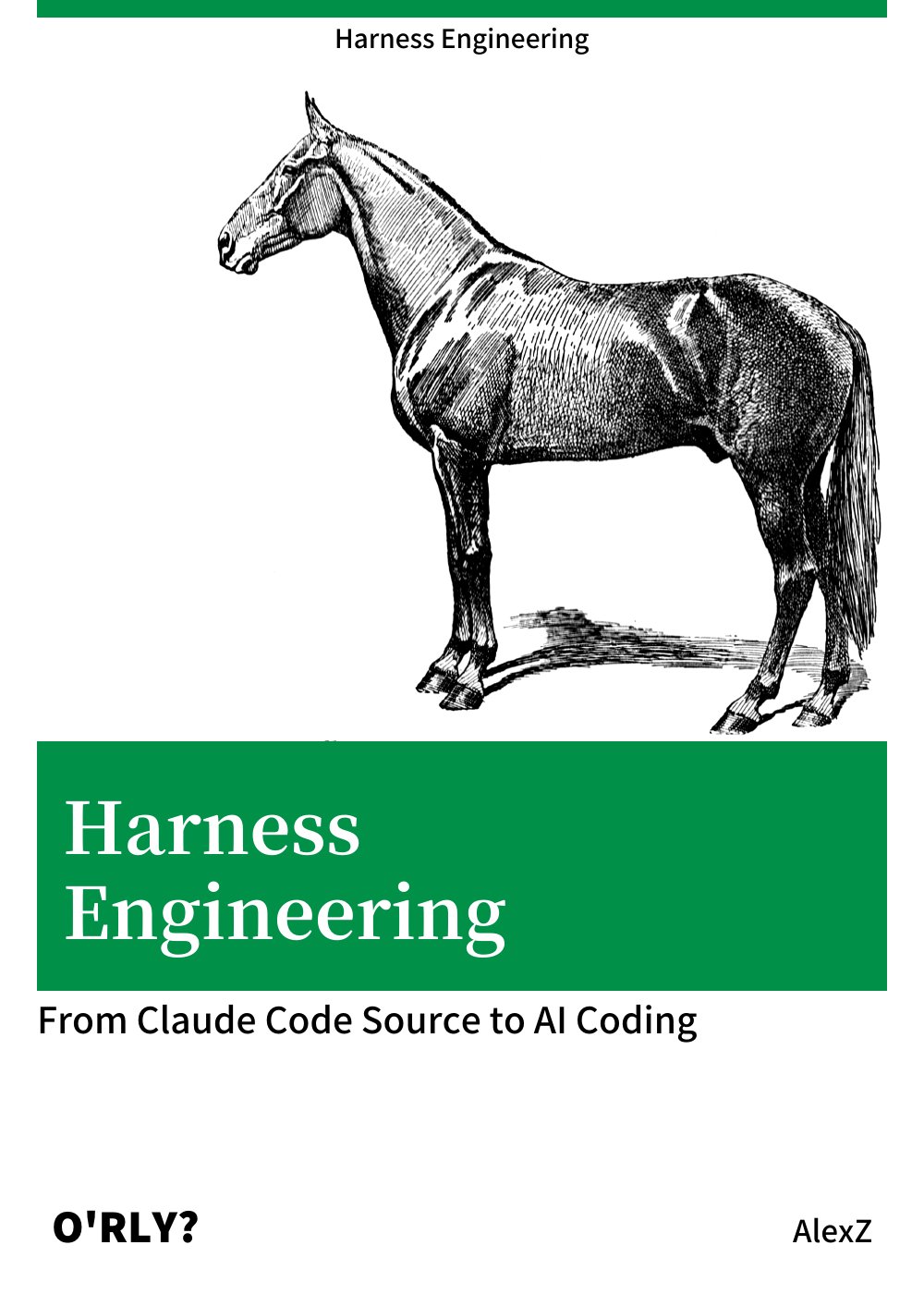
Harness Engineering — known informally in Chinese as "The Horse Book" (because the Chinese title sounds like "harness" as in horse harness).
I believe the best way to "consume" the Claude Code source code is to transform it into a book for systematic learning. For me, learning from a book is more comfortable than reading raw source code, and it makes it easier to form a complete cognitive framework.
So I had Claude Code extract a book from the leaked TypeScript source code. The book is now open-sourced, and everyone can read it online:
- Repository: https://github.com/ZhangHanDong/harness-engineering-from-cc-to-ai-coding
- Read online: https://zhanghandong.github.io/harness-engineering-from-cc-to-ai-coding/
If you want to read the book while gaining a more intuitive understanding of Claude Code's internal mechanisms, pairing it with this visualization site is highly recommended:
- Visualization site: https://ccunpacked.dev
To ensure the best possible AI writing quality, the extraction process was not as simple as "throw the source code at the model and let it generate." Instead, it followed a fairly rigorous engineering workflow:
- First, discuss and clarify
DESIGN.mdbased on the source code — that is, establish the outline and design of the entire book. - Then write specs for each chapter, using my open-source
agent-specto constrain chapter objectives, boundaries, and acceptance criteria. - Next, create a plan, breaking down the specific execution steps.
- Finally, layer on my own technical writing skill before having the AI begin formal writing.
This book is not intended for publication — it's meant to help me learn Claude Code more systematically. My basic judgment is: AI certainly won't write a perfect book, but as long as the initial version is open-sourced, everyone can read, discuss, and gradually improve it together, co-building it into a truly valuable public-domain book.
That said, objectively speaking, this initial version is already quite well-written. Contributions and discussions are welcome. Rather than creating a separate discussion group, all related conversations are hosted on GitHub Discussions:
Reading Preparation
Prerequisites
This book assumes readers have the following basics — you don't need to be an expert, just able to read and understand:
- TypeScript / JavaScript: All source code in the book is TypeScript. You need to understand
async/await, interface definitions, generics, and other basic syntax, but you don't need to write it. - CLI development concepts: Processes, environment variables, stdin/stdout, subprocess communication. If you've used terminal tools (git, npm, cargo), these concepts are already familiar.
- LLM API basics: Understanding the messages API (system/user/assistant roles), tool_use (function calling), streaming (streamed responses). If you've called any LLM API, that's enough.
Not required: React / Ink experience, Bun runtime knowledge, Claude Code usage experience.
Recommended Reading Paths
The book's 30 chapters are organized into 7 parts, but you don't have to read from start to finish. Here are three paths for readers with different goals:
Path A: Agent Builders (if you want to build your own AI Agent)
Chapter 1 (Tech Stack) → Chapter 3 (Agent Loop) → Chapter 5 (System Prompt) → Chapter 9 (Auto Compaction) → Chapter 20 (Agent Spawning) → Chapters 25-27 (Pattern Extraction) → Chapter 30 (Hands-on)
This path covers architecture to loop to prompts to context management to multi-agent, culminating in Chapter 30 where you build a complete code review Agent in Rust.
Path B: Security Engineers (if you care about AI Agent security boundaries)
Chapter 16 (Permission System) → Chapter 17 (YOLO Classifier) → Chapter 18 (Hooks) → Chapter 19 (CLAUDE.md) → Chapter 4 (Tool Orchestration) → Chapter 25 (Fail-Closed Principle)
This path focuses on defense in depth — from permission models to automatic classification to user interception points, understanding how Claude Code balances autonomy and safety.
Path C: Performance Optimization (if you care about LLM application costs and latency)
Chapter 9 (Auto Compaction) → Chapter 11 (Micro Compaction) → Chapter 12 (Token Budget) → Chapter 13 (Cache Architecture) → Chapter 14 (Cache Break Detection) → Chapter 15 (Cache Optimization) → Chapter 21 (Effort/Thinking)
This path covers context management to prompt caching to reasoning control, understanding how Claude Code reduces API costs by 90%.
About chapter numbering: Some chapters have letter suffixes (e.g., ch06b, ch20b, ch20c, ch22b) — these are in-depth extensions of main chapters. For example, ch20b (Teams) and ch20c (Ultraplan) are deep dives into ch20 (Agent Spawning).
Book Knowledge Map
graph TD
    P1["Part 1<br/>Architecture"]
    P2["Part 2<br/>Prompt Engineering"]
    P3["Part 3<br/>Context Management"]
    P4["Part 4<br/>Prompt Cache"]
    P5["Part 5<br/>Safety & Permissions"]
    P6["Part 6<br/>Advanced Subsystems"]
    P7["Part 7<br/>Lessons"]

    CH03(("Chapter 3<br/>Agent Loop<br/>🔗 Book Anchor"))

    P1 --> P2
    P1 --> P3
    P1 --> P5
    P2 --> P3
    P3 --> P4
    P5 --> P6
    P2 --> P6
    P3 --> P6
    P1 --> P7
    P2 --> P7
    P3 --> P7
    P5 --> P7

    CH03 -.->|"When tools execute in the loop"| P1
    CH03 -.->|"When prompts are injected in the loop"| P2
    CH03 -.->|"When context is compressed in the loop"| P3
    CH03 -.->|"When permissions are checked in the loop"| P5

    style CH03 fill:#f47067,stroke:#fff,color:#fff
    style P1 fill:#58a6ff,stroke:#30363d
    style P2 fill:#3fb950,stroke:#30363d
    style P3 fill:#d29922,stroke:#30363d
    style P4 fill:#d29922,stroke:#30363d
    style P5 fill:#f47067,stroke:#30363d
    style P6 fill:#bc8cff,stroke:#30363d
    style P7 fill:#39d353,stroke:#30363d
Chapter 3 (Agent Loop) is the book's anchor — it defines the complete cycle from user input to model response. Other parts each analyze the deep mechanisms of a particular stage within that cycle.
Reading Notation
This book uses the following conventions:
- Source references: Format is
restored-src/src/path/file.ts:line, pointing to the restored source of Claude Code v2.1.88. - Evidence levels:
- "v2.1.88 source evidence" — has complete source code and line number references, highest confidence
- "v2.1.91/v2.1.92 bundle reverse engineering" — inferred from bundle string signals; Anthropic removed source maps starting from v2.1.89
- "Inference" — speculation from event names or variable names only, no direct source evidence
- Mermaid diagrams: Flowcharts and architecture diagrams use Mermaid syntax, rendered automatically when reading online.
- Interactive visualizations: Some chapters provide D3.js interactive animation links (marked as "click to view"), which need to be opened in a browser. Each animation also has a static Mermaid diagram as a fallback.